

Building a robust vocabulary doesn’t require long lessons or expensive programs. What matters most is how words are introduced and revisited over time. With a simple, repeatable routine, vocabulary growth can happen naturally alongside reading, writing, and everyday learning at home.
And it should be a present component throughout a child’s education—not just in the younger grades or not just in the months before the SATs®.
Here are five brain-science-backed strategies to help your students expand their vocabulary, no matter their age, so they are ready for college and the workforce.
The most meaningful vocabulary words often come from books, articles, videos, or conversations students are already engaging with. When a new or interesting word comes up, write it down along with the sentence or passage where it appeared. Keeping that original context helps the word make sense and gives it a purpose beyond memorization.
Invite your students to be active “finders” of their vocabulary words—in books they read, in movies they watch, on signs they see around town.
Instead of jumping straight to a dictionary definition, have students describe what they think the word means using their own language. They can explain it, give examples, or connect it to something familiar. This step helps move the word from recognition to real understanding.
Keep a journal or log to record these words, their definitions, and examples.
Looking at similar and opposite words helps clarify meaning and builds nuance. When students compare words, they start to see subtle differences in tone and usage, which strengthens both reading comprehension and writing skills.
Challenge students to come up with their own first, then look up additional ones in a dictionary. Add these to the word’s entry in your student’s journal.
Creating original sentences is where vocabulary really starts to stick. Encourage students to write or say a few sentences using the word in different ways. This practice helps them apply the word correctly and confidently. Make it a challenge to use the words in funny or interesting ways.
Ask your child how the word could describe something in their own life, a current event, or a real-world situation. When vocabulary feels relevant and personal, it’s far more likely to be remembered and used naturally later on.
This five-step approach is the same structure I use in my Vocabulary Builder workbook series. I created this series to work across the middle and high school grades, so you can dive in regardless of where your child is in those grades. Each one contains 180 words and is designed to cover a full year.
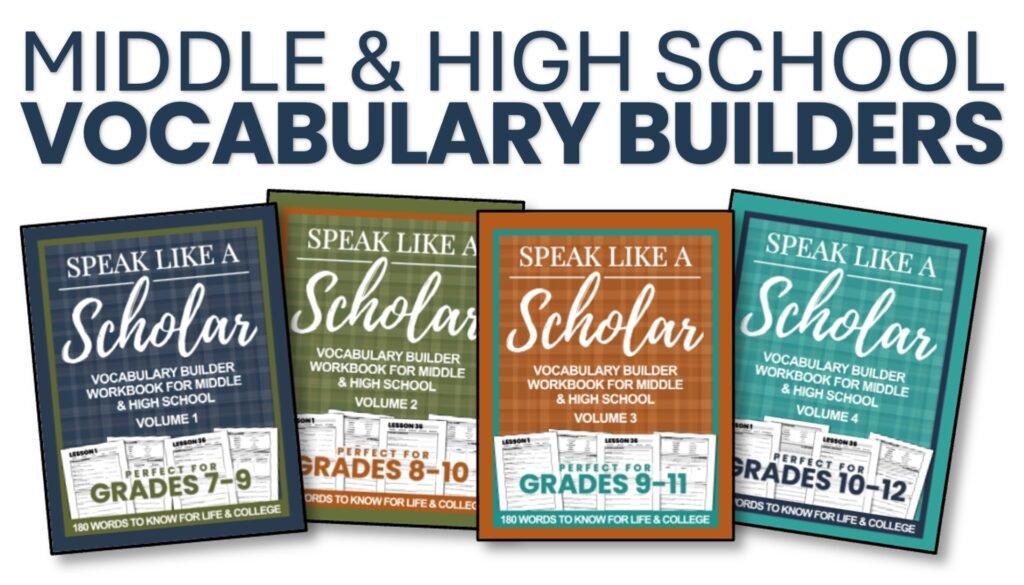
Below are the suggested grade ranges for each book.
Volume 1 – Grades 7-9 | Volume 2 – Grades 8-10
Volume 3 – Grades 9-11 | Volume 4 – Grades 10-12
Happy vocabulary building!
Erin from Let’s Cultivate Greatness